1977: The Year Geek Culture Was Born
Before Comic-Con sold out and Marvel owned the box office, one year assembled every building block of modern nerd culture. It was 1977. Here's the proof.

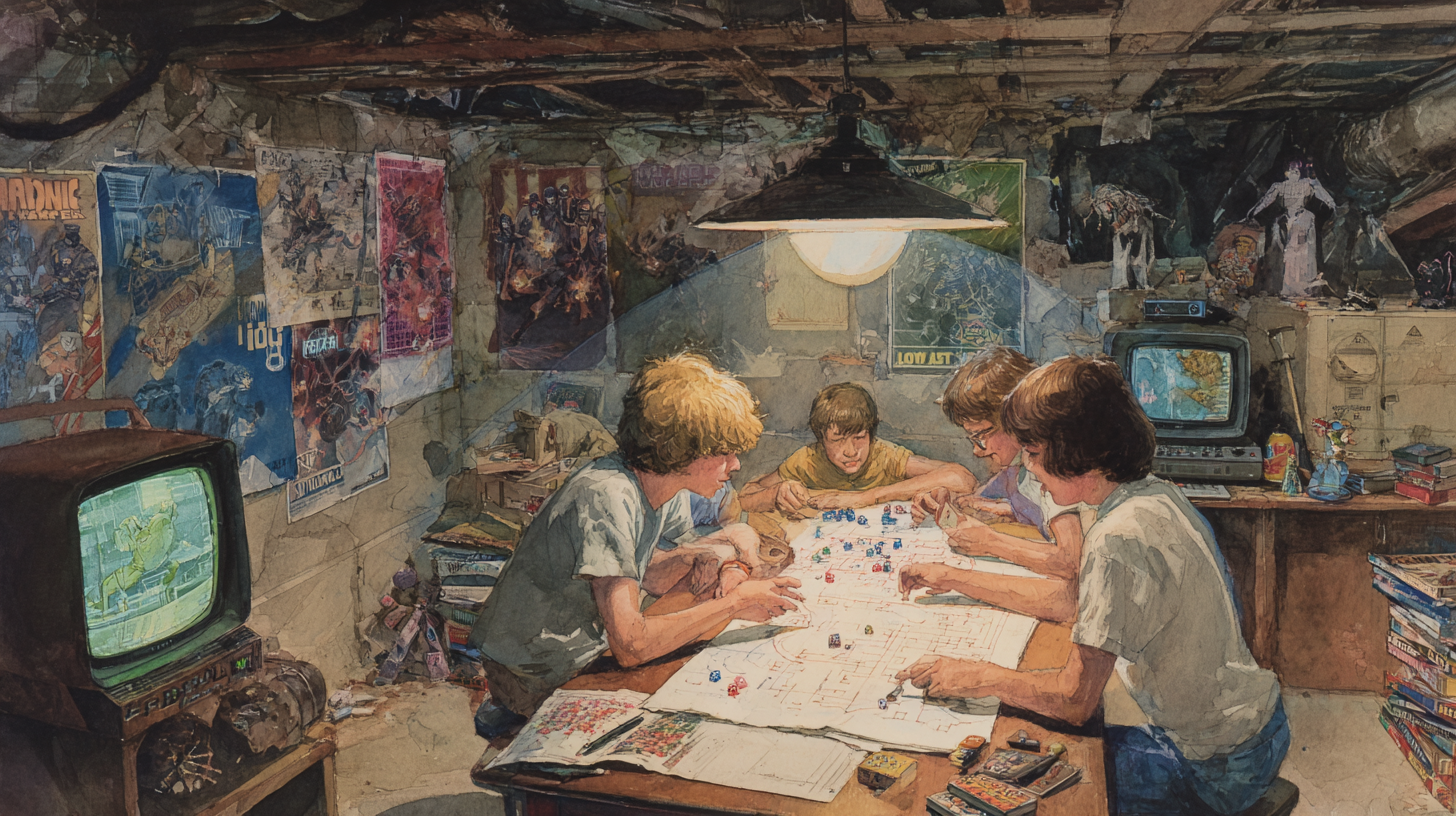
Long before Comic-Con sold out in minutes and Marvel owned the box office, one single year quietly assembled every building block of modern nerd fandom — and most of us were too young to realize what was happening.
Ask any Gen X nerd to name the most important year of their childhood, and there's a very good chance the answer is 1977.
Not because it was the year of any single thing. But because it was the year of everything — arriving from every direction simultaneously, as if the universe had decided to run all the DLC at once.
A film that rewired what movies could be. Comics that were building toward something legendary. Tabletop games that handed kids entire worlds to inhabit. The first real home computers. Action figures. Trading cards. Magazines that told you being a fan was not just acceptable but exciting.
This is not nostalgia. This is archaeology. Because if you want to understand how geek culture became the dominant cultural force it is today, you have to go back to 1977 and understand what got planted there.
The Films That Changed Everything
Star Wars
On May 25, 1977, George Lucas released a space fantasy about a farm kid, a wizard, a princess, twin suns, and a villain in a black mask — and nothing was ever the same.
Star Wars was not just a film. It was a mythology delivery system. It gave an entire generation a shared universe — a cosmology with its own history, species, factions, and moral stakes — at an age when we were just learning what those words meant. Kids who saw it in May were desperate for more by June, which is why the Alan Dean Foster novelization (published under George Lucas's name) became one of Scholastic's best-selling book-order titles before the year was out.
More on what Star Wars spawned in a moment. Because the cultural footprint was not just cinematic.
Close Encounters of the Third Kind
While Star Wars gave kids a universe to fight in, Steven Spielberg's Close Encounters of the Third Kind gave adults — and the braver kids — a universe to wonder at. Where Star Wars was mythological adventure, Close Encounters was awe. Alien contact framed not as invasion but as invitation. It asked what it would feel like to be chosen, to be called toward something enormous you couldn't name.
Two massive science fiction films in the same summer. That doesn't happen. It happened in 1977.
Marvel Comics: The Bronze Age at Full Boil
In 1977, the Marvel spinner rack was doing something extraordinary — and most of the kids buying those comics off the newsstand had no idea they were watching a creative peak happen in real time.
The X-Men Find Their Voice
Chris Claremont and Dave Cockrum were deep into what would become one of the most celebrated runs in comic book history. The All-New X-Men — Storm, Wolverine, Colossus, Nightcrawler, Cyclops — were getting real character work, real emotional stakes, real weight. Issues #105 through #109 in 1977 are where the book stops being a comeback story and starts being a phenomenon. The seeds of the Dark Phoenix Saga are already germinating.
John Byrne, who would take over penciling duties in 1978 and help define the book's visual identity for years, was already breaking out on Iron Fist — clean, kinetic, dynamic in ways that stood apart from everything else on the rack.
Marvel Team-Up and the Crossover as Currency
Marvel Team-Up put Spider-Man with a rotating cast of the Marvel universe every single month, and in 1977 Sal Buscema was delivering reliable, skilled Bronze Age storytelling that kept the spinner rack full. Every issue was a crossover before crossovers were an event. For kids collecting on a budget, Team-Up was the sampler platter that made you want to buy everything else.
Conan: A Publishing Empire in Sword and Sorcery
By 1977, Roy Thomas and John Buscema had turned Conan the Barbarian into a genuine publishing line — and the quality was legitimately high.
The monthly color book was running through the Belit era, the pirate queen who becomes Conan's great love, and Buscema's action sequences were doing things with sword-and-sorcery storytelling that nobody else in the medium was matching. But the real gem was Savage Sword of Conan — the black-and-white magazine-format companion series that wasn't subject to the Comics Code. More violence, more moral complexity, more fidelity to Robert E. Howard's original pulp source material. Buscema and Alfredo Alcala in black and white were producing work that holds up beautifully today.
The combined Conan publishing line in 1977 was putting out more quality sword-and-sorcery content per month than the entire rest of the comics industry combined. And it was bringing Howard's Hyborian Age to kids who would never have found the pulp paperback reprints on their own.
Tabletop RPGs: Two New Worlds to Live In
Traveller
In September 1977 — the same month the Atari 2600 launched, because 1977 had no chill — Game Designers' Workshop released Traveller, the first serious science fiction tabletop RPG. Three small black books. Starships. Alien worlds. A character creation system that could, famously, kill your character before the campaign started.
The fact that Traveller shipped the same year Star Wars opened is almost too perfect. Every kid who saw the film in May and wanted to live in that universe had a system for doing it by fall. Marc Miller's design philosophy — hard SF, consequences, no hand-holding — is still influential. The black books are a design artifact that holds up.
D&D Gets Organized
1977 is the year D&D stops being a weird wargaming footnote and becomes a product line. The Holmes Basic Set — Dr. J. Eric Holmes's edited and reorganized introduction to Dungeons & Dragons — gives the game a clear on-ramp for new players. The Monster Manual drops. The hobby begins its expansion into the mainstream that will make Dungeons & Dragons a household name by the early 1980s.
For anyone who got their first dungeon crawl in 1977 or 1978, Holmes Basic is where it started. The blue book. The crayon. The gelatinous cube.
Video Games and Tech: A Civilization Event
Here is the part of 1977 that does not get enough credit in the cultural conversation, because the Star Wars gravitational field pulls all the attention.
Three personal computers launched in 1977 — the Apple II, the TRS-80 Model I, and the Commodore PET — in the same calendar year. Historians call this the 1977 Trinity. It is not a coincidence. It is a civilization event. Three companies independently concluded that the personal computer was ready for consumers, and they were all correct, and nothing was the same after.
The Apple II in particular — with its color graphics, open expansion slots, and BASIC built into ROM — was Woz's design philosophy in silicon. It turned hobbyists into an industry.
And in September of that same year, Atari launched the 2600. Joystick. Cartridges. A rotating library of games you could take to a friend's house. The living room arcade became real.
Kids in 1977 were pumping quarters into Breakout and Night Driver at arcades in the afternoon, going home to unbox an Atari 2600, and doing their homework on a TRS-80. The digital world was not coming — it had arrived, quietly, while everyone was watching Star Wars.
Trading Cards: The Original Collectible Economy
Before NFTs, before Pokémon packs, before any of it — there were Star Wars trading cards, and they ran the elementary school economy of 1977.
It started with Wonder Bread. Literally. Series 1 Star Wars cards were inserted into loaves of Wonder Bread, which meant that getting specific cards required either a lot of sandwiches or a neighborhood trading network. Kids were knocking on doors. Deals were being made at lunch tables. The concept of "I need this card to complete the set" was being installed in an entire generation's psychology.
Then Topps got involved. The Topps Star Wars card series — five series released through 1977 and 1978, with the iconic blue borders of Series 1 — became the definitive collectible of the era. Stickers. Puzzles on the backs. Those slightly-off color photos from the film. And the smell of that flat stick of pink gum that you ate anyway.
Here is a thing that actually happened: kids traded Charlie's Angels cards — which Topps was also producing in 1977, featuring Farrah Fawcett and Jaclyn Smith — with the girls at school, in exchange for Star Wars cards. The cross-IP trading economy was real. Farrah Fawcett was currency. This is documented history.
Close Encounters of the Third Kind got its own card set too — another Topps production — which felt slightly more mysterious and less action-packed than Star Wars cards but occupied the same place in the rotation for kids who had seen both films and needed to own some piece of both.
Star Wars Toys: The Accidental Pre-Order
Kenner had a problem in Christmas 1977. They had the Star Wars toy license but couldn't manufacture the action figures fast enough to meet demand. Their solution was one of the most audacious moves in toy history: the Early Bird Certificate Package.
You bought a box — an empty box — that contained a certificate promising you four action figures when they were ready. Luke Skywalker, Princess Leia, R2-D2, and Chewbacca. Shipped in early 1978.
Parents bought their children the promise of toys for Christmas. And it worked.
When the figures finally arrived — 3.75 inches, the perfect scale for playability, revolutionary at the time — they sold at a scale nobody had seen before. By 1978 Kenner had a full line: X-Wings, TIE Fighters, the Millennium Falcon, the Death Star playset. The action figure as we understand it — small, interchangeable, part of a larger universe of compatible vehicles and environments — is essentially a post-Star Wars invention. Kenner built the template. Everything since has been a variation.
Books and Other Nerd Fuel
The fantasy bookshelf in 1977 stopped being a niche and became a commercial category, and one book is largely responsible.
The Sword of Shannara by Terry Brooks became the first fantasy novel to appear on the New York Times bestseller list. Ballantine used it to launch their Del Rey imprint. It was Tolkien-derivative by any honest measure, but it landed at exactly the right moment — and its commercial success proved that an audience existed. Everything that followed on the fantasy shelf owes something to Shannara doing the numbers it did in 1977.
The Silmarillion — posthumous Tolkien, edited by Christopher — dropped the same year and delivered the mythological deep-dive that fans had been waiting for since the appendices of Return of the King. The Ainulindalë. The full history of Númenor. The tragedy of Turin in full. It is not a casual read. It sold anyway.
Lord Foul's Bane by Stephen R. Donaldson launched the Thomas Covenant series — darker, morally complicated, a fantasy protagonist who actively resists the hero role. The literary counterweight to Shannara's populism.
Gateway by Frederik Pohl swept the Hugo, Nebula, and Locus awards the following year. Heechee alien artifacts, a lottery-based space exploration premise, psychoanalysis framing. One of the best science fiction novels of the decade.
And A Scanner Darkly — Philip K. Dick writing from inside the thing he was warning you about. Surveillance, identity collapse, and a kind of sadness that has never really left the book.
The Newsstand: Where the Future Was Being Described
Two magazines launched in 1977 that deserve their own place in the nerd canon.
Omni magazine hit newsstands in October 1977, published by Bob Guccione and edited by Kathy Keeton. It was a science and science fiction magazine that took both seriously — peer-reviewed science alongside original fiction by the best SF writers alive, wrapped in photography and design that made the future look genuinely beautiful. It ran interviews with scientists and futurists, covered consciousness research and space exploration and genetic engineering, and treated its readers as intelligent adults who could hold complicated ideas. For a generation of young nerds who wanted more than pulp but weren't ready for academic journals, Omni was a revelation.
Byte magazine, launched just a bit earlier in 1975 but finding its legs and its audience squarely in the 1977 personal computer moment, was the technical companion to the 1977 Trinity of home computers. If Omni was the dream, Byte was the instruction manual. Deep technical coverage of microprocessors, programming, hardware builds. The hobbyist who read Byte in 1977 and built a computer from the plans inside it is the same person who was writing software ten years later. Byte was where the engineers were being made.
Scholastic Book Fairs and Dynamite Magazine: The Pipeline
All of the above existed in a world where kids had limited money and limited access. Scholastic solved the access problem.
The Scholastic Book Order form is one of the great artifacts of 1970s childhood. A single newsprint sheet listing paperbacks for somewhere between 35 cents and a dollar fifty, handed out by your teacher, circled in pencil, sent home with a check — and three weeks later a box arrived at your classroom and your name was called. It was mail order before anyone called it that. It was personalized retail before algorithms. And in 1977, it was how millions of kids got their hands on the Star Wars novelization and a dozen other things they would not have found any other way.
The Book Fair — the traveling popup that set up in your school gymnasium for two days — was a different and more electric experience. A retail event in an environment where you were otherwise not allowed to buy things. The smell of the paperbacks. The wire racks spinning. The erasers shaped like animals that you definitely bought instead of something you would actually read.
And then there was Dynamite.
Dynamite was a Scholastic publication — a kids' pop culture magazine sold exclusively through the book order form and the Book Fair — and in 1977 it was at its peak. Launched in 1974, it covered the intersection of movies, TV, sports, and pop culture for exactly the demographic that was simultaneously discovering Star Wars, reading comics, and collecting Topps cards. It had puzzles and posters and jokes and interviews with whoever was famous that month.
What made it significant was something harder to quantify. Dynamite treated its readers as real fans with real enthusiasms rather than just consumers of product. It normalized the idea that being excited about science fiction and fantasy and comic books was legitimate — that it was, in fact, a cultural identity worth having. A kid reading Dynamite in 1977 was being told, in the most accessible way possible, that their interests mattered.
The Dynamite poster from 1977 was almost certainly a Star Wars poster. It was on a lot of bedroom walls.
Final Thought
Star Wars opens in May. The Atari 2600 launches in September. The Apple II ships in April. The Sword of Shannara hits the New York Times list. Traveller ships in the same month as the 2600. Omni magazine hits the newsstand in October. The X-Men are finding their voice. Conan is at his peak. The Topps Star Wars cards are in everyone's hands.
All of this in a single calendar year.
This is not a good year for geek culture. This is the founding year of geek culture as we know it. The conventions, the franchises, the collectibles, the gaming tables, the immersive experiences — all of it traces a direct line back to 1977, to the things that landed in kids' hands and hearts that year and never really let go.
At OGAN Labs, we build spaces that celebrate exactly this: the joy of stories, the power of play, the community that forms when passionate people find each other around shared enthusiasms. Those communities didn't start at San Diego Comic-Con or on Reddit.
They started at a school library with a wire rack full of paperbacks. They started with a folded order form and a crayon circle. They started in a dark movie theater in May of 1977, when the crawl began and the stars appeared.
We're still living in that galaxy.
OGAN Labs: Building the future of fandom, one experience at a time.